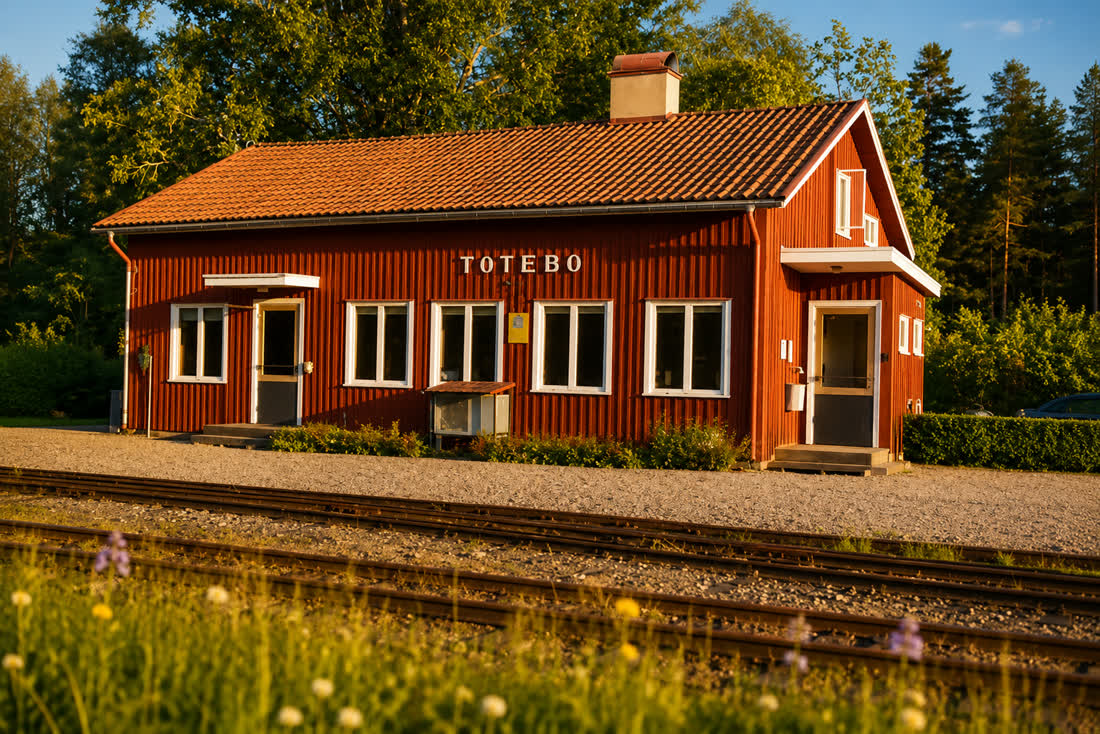
A station that's still alive
The small station building in Totebo was built in 1877–1879, when the narrow-gauge railway between Västervik and Hultsfred was constructed — one of the smallest building types along the entire line, with an attached garden, as was customary at the time. Unlike many disused rural stations in Sweden, Totebo never became a ruin: in 1979, a group of railway enthusiasts from Västervik founded the Tjustbygdens Järnvägsförening (TJF), originally to preserve the historic steam locomotive NVHJ 22 and other old rolling stock. The first trip for members took place in December 1981, and the first public run followed in August 1982 between Västervik and Gunnebobruk — drawing large crowds.
Since 2003, a historic railbus has once again run the complete, 70 km route between Hultsfred and Västervik every summer, with an actual steam locomotive on parts of the line. The association now owns Sweden's largest collection of narrow-gauge railbuses — nine vehicles of the YBo5p type, originally ordered by the state railway SJ and built in Umeå. Totebo is one of the stations along this route, located between Fårhult and Västervik.
For guests at Ullevi, that means a piece of living, volunteer-run railway history sits literally at the doorstep.
By railbus or steam locomotive
Runs take place only on selected summer days — always check current dates, steam-locomotive weeks and timetables at smalsparet.se, as operations shift a little from year to year. The ride itself is the real destination: past forests, small lakes and meadows, at the unhurried pace of an era when railways were still opening up the countryside. If you time it well, you can take the modern Krösatågen to Hultsfred and change there in summer onto the heritage railway toward Totebo and Västervik — two very different train experiences in a single day.
The practical starting point: Vimmerby
For day trips by modern regional train, Totebo itself isn't the starting point — only the heritage railway runs here, and only in summer. The practical gateway is Vimmerby, less than 25 minutes by car from Ullevi. From there, the Krösatågen regional line runs several times a day on the through route Linköping–Kalmar, which also serves Hultsfred — the change point for the heritage railway.
Kalmar: a castle, a cathedral, and cobblestone lanes
About 1 hour 50 minutes' travel time, six connections a day. Kalmar Slott — once called "Rikets nyckel", the key to the kingdom, for its strategic position on the former border with Denmark — began as a simple defensive tower in the 12th century. In the late 13th century, Magnus Ladulås had a fortified compound with a curtain wall built; the castle only took on its present appearance in the 16th century, when Gustav Vasa and his sons Erik XIV and Johan III, with the help of the German master builder Jakob Richter, transformed the medieval castle into a Renaissance palace after continental models. Today, Kalmar Slott is considered the best-preserved Renaissance castle in Northern Europe. Right next door lies the old town with its cobblestone lanes, and on Kvarnholmen rises the massive, yellow 17th-century Kalmar Cathedral — one of Sweden's most striking Baroque churches.
Linköping: Sweden's oldest secular building still in use
About 1 hour 20 minutes' travel time, seven connections a day. Linköping Cathedral is one of Sweden's best-preserved medieval cathedrals: 110 metres long, with a 107-metre-high tower, begun in the early 12th century as a Romanesque basilica and rebuilt in the 13th century into a three-nave Gothic hall church. Directly opposite stands Linköping Castle — with parts dating from the 12th century, the oldest secular building in Sweden still in use. The adjoining Castle and Cathedral Museum holds medieval textiles and silverwork. Afterwards, you can stroll across Stora Torget and along the historic Stora Gatan.
Kisa: where Swedish emigration to America began
About 30 minutes' travel time from Vimmerby — a smaller stop, but one with a genuinely remarkable story. In the quiet town of Kisa on Lake Kisasjön stands the Kisa Emigrant Museum, in the very house where Swedish emigration history began: in 1845, farmer and builder Peter Cassel set off with 21 fellow countrymen to found the first Swedish colony, "New Sweden", in what is now Iowa — the first organised emigration from Sweden. Redesigned in 2019, the museum uses sound installations to tell the stories of individual emigrants. Right next door, Café Columbia — named after the Swedish-American returnee Dorothéa Florén and running since 1921 — invites you in for a break in an 18th-century building.
What about Astrid Lindgren's World?
If you're already setting off from Vimmerby: Astrid Lindgren's World is only two minutes away by train. Everything about that trip is already covered in our article Astrid Lindgren's World: The Great Family Day Out from Ullevi.
The destinations at a glance
Totebo sits on the heritage railway, Vimmerby is the starting point of the modern Krösatågen — and in between lies Hultsfred, the change point between both railways.
Good to know
Krösatågen timetables and fares change from time to time — for current times and tickets, check krosatagen.se or the Östgötatrafiken/Kalmar Länstrafik apps; tickets aren't sold on board. The heritage railway's Totebo dates are listed at smalsparet.se.