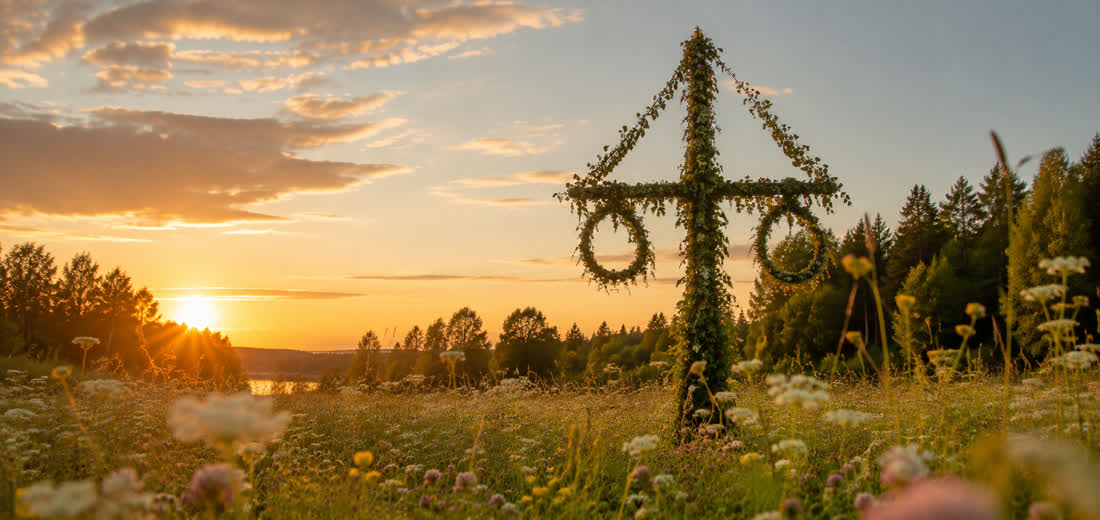
The day Sweden stands still
There's this one Friday evening each year, usually somewhere between the 19th and 25th of June, when Sweden's big cities suddenly feel deserted. Stockholm empties out, offices close early, the streets fall quiet — and at the very same time, far out in the countryside, in gardens, meadows and by lakeshores like here in Småland, the land wakes up to a celebration older than Christianity itself. Midsummer is the moment when Swedes drop everything for a day or two to do exactly what their ancestors did centuries ago: celebrate the longest stretch of light before the nights start drawing in again.
If you've never experienced it, it's easy to underestimate the feeling. The sun barely properly sets in Småland at this time of year — it turns dusky, golden, but never truly dark. You sit outside, eat, sing, dance, and at some point you simply lose track of how late it is, because the light never gives it away.
Ancient roots, a Christian veneer
The celebration of the summer solstice reaches back long before the Viking age — a festival honouring the sun, fertility and light, at a time when Sweden's short, bright summers could genuinely mean the difference between life and death. Later, with Christianisation, St John's Day (honouring John the Baptist, on 24 June) was laid over the old pagan festival — the church gave it a new name, but the celebration itself remained remarkably unchanged. To this day, Midsummer is celebrated on the Friday closest to 24 June as Midsommarafton (Midsummer's Eve), with the Saturday after as Midsommardagen — a public holiday across the whole country.
The midsummer pole: heart of the festival
At the centre of every Midsummer celebration stands the midsommarstång, the midsummer pole — a tall wooden mast, often shaped like a cross with two hanging rings, entirely wrapped in birch leaves, meadow flowers and green branches. Decorating the pole is itself a small ritual: families, friends and neighbours gather flowers and greenery together, weave, tie, laugh — and once the pole is fully dressed, it's raised together, by many hands at once. From that moment on, the space around it belongs to the dancing.
A particularly lovely side custom: many women and children — and increasingly men too — wear their own hand-woven flower crowns in their hair that day, made from meadow flowers and herbs. It's almost as much a part of the day's picture as the pole itself.
Little frogs and a lot of fun
Once the pole is up, the dancing begins — and not always elegantly. By far the best-known Midsummer song is "Små grodorna" ("The Little Frogs"), where young and old alike hop around the pole in a circle, croaking and holding their arms up like frog legs by their heads. It's silly, it's loud, and that's exactly why everyone loves it — children just as much as grandparents who danced it themselves as kids. If you experience Midsummer in Sweden, sooner or later you'll be dancing along too, whether you meant to or not.
The table: herring, strawberries, and a schnapps to sing to
Midsummer has its fixed culinary rituals too. Every table features several kinds of pickled herring (sill) in different marinades, alongside new potatoes with dill and spring onions, often accompanied by a cold beer or a schnapps (nubbe) — sung to, of course, since a proper Midsummer feast without drinking songs (snapsvisor) is hard for many Swedes to imagine. The crowning finish is the year's first home-grown strawberries, often with cream — for many Swedes, THE taste of summer, the culinary highlight of the entire year.
A dream under the pillow
Midsummer also carries a little piece of folklore that's still lovingly kept alive today: whoever silently gathers seven (sometimes nine) different kinds of flowers on Midsummer night and places them under their pillow is said to dream that night of the person they will one day marry. Whether you believe it or not, it's a charming, almost childlike ritual that makes the night feel just a little more magical.
Why Midsummer feels especially special in Småland — and especially at Ullevi
Midsummer can be celebrated anywhere in Sweden, but nowhere does it feel as complete as out in the countryside — and few regions embody that as well as Småland. While Dalarna or the Stockholm archipelago often draw crowds of visitors at Midsummer, the celebration here stays refreshingly genuine: small hembygdsgården (heritage farms), neighbours who've known each other for years, a pole still dressed by hand, no entry fee, no crowds. It's exactly the Småland that Astrid Lindgren described in her stories of Bullerbyn and Lönneberga — a summer that smells of freshly cut grass, wildflower meadows and long, bright evenings.
And right in the middle of it all sits Ullevi. Not a hotel room, not a holiday park, but your own house with your own garden, direct lake access to Nässjön and Hällsjön, and forest right at the door — exactly the backdrop a Midsummer night needs. If you'd like, you can celebrate entirely privately: your own small pole in the garden, weaving flower crowns by the water, herring and strawberries on your own terrace, until the sun finally, briefly dips below the horizon. And if you'd rather immerse yourself in the real, living tradition, you're just minutes by car from the public celebrations in Vimmerby or Rumskulla — so on this one day of the year, you don't have to choose between peace and community. Both are, quite literally, right next to each other.
For families, there's one more thing: Midsummer is one of the few festivals where genuinely every generation dances along — grandparents just as much as toddlers. In a house like Ullevi, which is built for exactly this kind of multi-generational stay, that fits right in.
Experience Midsummer up close: celebrations around Ullevi
The lovely thing about Midsummer in Småland: you don't need to host it yourself to join in. In the area around Vimmerby and Västervik, there are traditional, public celebrations where everyone is welcome:
- Gästgivarhagen, Vimmerby — dancing around the pole, a performance by the Vimmerby folk dance group in traditional costume, music, coffee and Korv med bröd (hot dog)
- Hembygdsgården Rumskulla — a traditional celebration with dancing around the pole, coffee and strawberry cake
- Hembygdsparken Tuna — the midsummer pole is raised together, followed by dancing and games
- Lofta Hembygdsgård (near Västervik) — decorating the pole together, dancing, coffee served
Exact dates and times shift slightly from year to year — it's worth checking the website of the relevant hembygdsförening (local heritage association) or the local tourist office shortly before you arrive.
When to be at Ullevi for it
If you'd like to experience Midsummer in Småland, it's best to plan specifically for the last week of June — exactly the time that, according to our article Best Time to Visit Ullevi, is already one of the most sought-after of the whole year. If you want to secure this particular date, it pays to book well in advance — Midsummer week is regularly one of the first to be fully booked in Swedish lakeside houses.